
Article / Things We Changed Our Mind About
Listen After the First Take
A theater experiment, two radically different ways of making movies, and what it means to keep listening after you think you know what you're doing.
Updated October 12, 2026 Read earlier editions ↗
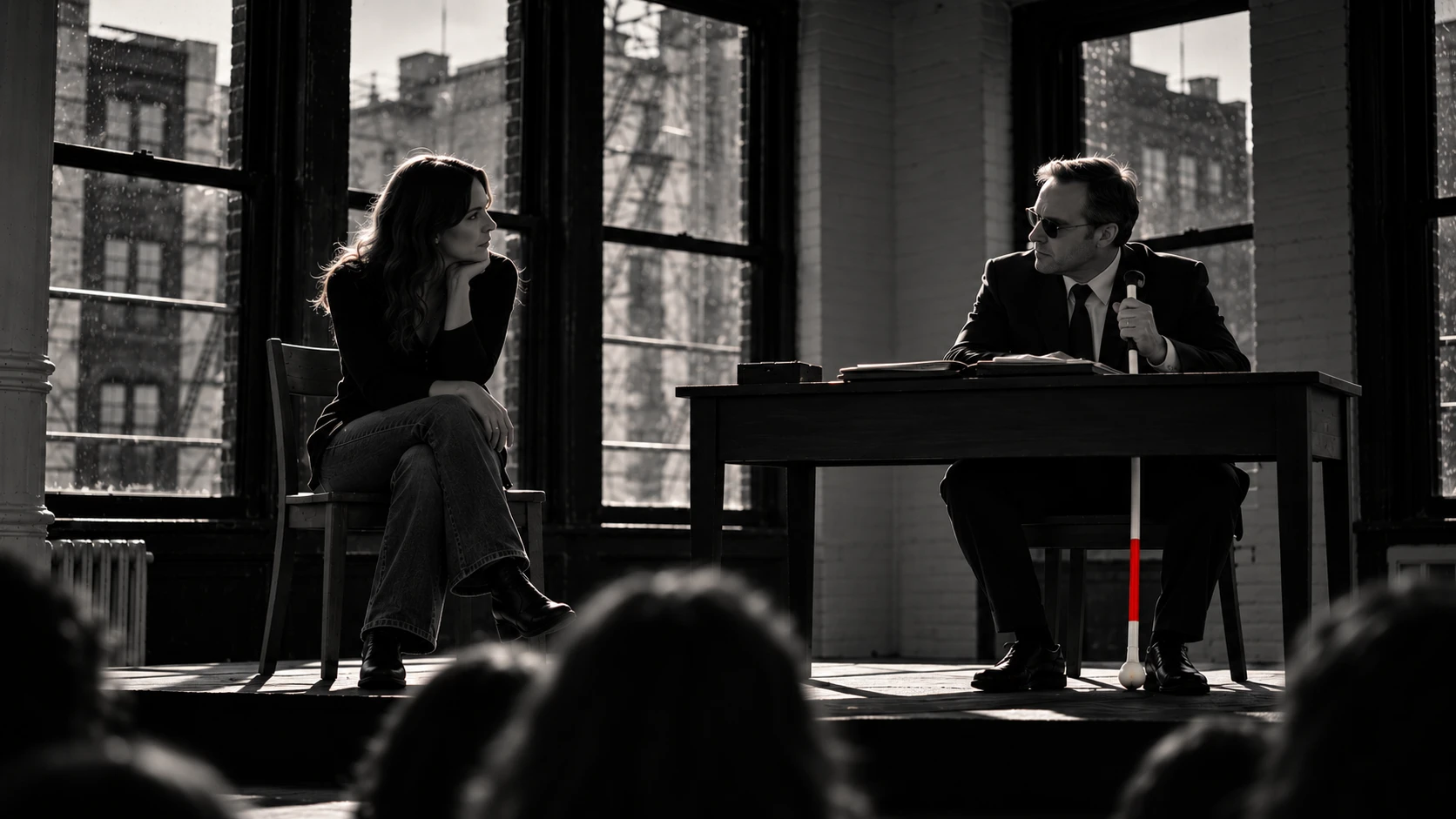
The theater laboratory of the Liminal Stage was at 2 Bleecker Street in NoHo, in an old loft with white walls, a white pressed-tin ceiling and enormous windows framed in dark green. At the end of the room, facing the windows, there was a simple black stage raised about two feet above the floor.
I was working with Alethea Allen under the direction of Dave Elliott. The scene was simple. I played a businessman who was blind. I wore dark glasses and carried a white cane with a red section. Alethea played an ingenue. The set amounted to a desk, my chair behind it and another chair available to her.
We had rehearsed the scene many times. We knew the lines. We knew where to stand, when to sit, where to move. We had established the interpretation and repeated it until the mechanics were no longer the problem.
Still, something about the scene was not alive.
I had a simple thought.
I am not actually blind. I can see her.
For one run, I stopped internally performing the premise that I could not see Alethea. I did not change the text. I did not change the blocking. I hit the same marks. The cane remained in my hand. The dark glasses remained on my face. The scene was still the scene.
I simply allowed myself to see her and look at her.
Alethea is a good actor. She immediately perceived that something had changed. I was looking directly at her, and her performance changed in response. The scene acquired an entirely new undercurrent.
Can this man actually see me?
Nobody had instructed her to play suspicion. I had not given her a note about what she should feel or how she should behave. We decided to hit the marks precisely, but in a different way: I gave her something to be suspicious about.
That distinction has stayed with me.
The scene became more alive because we were no longer maintaining an agreed fiction at the expense of what was actually happening between us. The premise still existed. The businessman was still supposed to be blind. The glasses and cane still belonged to the scene. But we now had a different fact to respond to.
Dave Elliott was...unhappy with the deviation from his interpretation. I understood why. He had directed the scene according to a particular idea of what it was doing, and I had introduced another possibility without changing a line or a mark.
That did not make the experiment right in every sense. It did reveal that the scene contained another viable interpretation.
At the time, I understood the practical result. Much later, I began to understand the method behind it.
Acting is reacting. Acting is listening.
That sounds elementary until you have spent enough time acting to discover how easy it is to do the opposite. You can become busy manufacturing a character. You can concentrate so hard on appearing to be angry, frightened, blind or in love that you stop receiving the other person. You can perform the idea of the scene while missing the scene itself.
Eventually, acting becomes less about manufacturing a character through artifice and more about being yourself truthfully inside artificial circumstances. The camera is artificial. The audience is artificial. The lights, marks and props are artificial. The circumstances may be invented.
The listening is not.
The other actor is there. Something is happening between you. The work depends on whether you can remain available to it.
That does not mean ignoring direction or treating every impulse as revelation. A scene has a contract. The text matters. The blocking matters. The other people in the room matter. An actor is not there to prove that personal spontaneity is more important than collaboration.
But a contract is not the same thing as a prison.
Film taught me another version of this.
A film actor's job is not necessarily to reproduce an identical performance take after take. The scene has to remain recognizably the same. The lines and major actions have to work. Continuity matters. The director needs to be able to assemble the material.
Within that contract, variation can be valuable.
A different pause can change the temperature of a line. A glance can reveal something the previous take concealed. A reaction can arrive earlier or later. A performance can discover an emphasis nobody planned in advance.
The finished film is not any individual take. It is constructed later from the material captured during production. The editor chooses. The director chooses. The rhythm of the finished scene emerges from decisions made after the actors have supplied the material.
Consistency has value. Perfect repetition can also leave post-production with less to work with.
The creativity is in the process. It is in preparing carefully enough to know the scene, then remaining open enough to discover what the scene can become.
I think about that when people talk about methodology as though a good method should produce the same result every time. A method can make a result more likely. It can reduce wasted motion. It can give people a shared language. It can turn experience into something reusable.
It cannot remove judgment.
Clint Eastwood and Stanley Kubrick are useful contrasts here, although neither needs to be turned into a lesson or a personality type.
Eastwood is associated with an extraordinarily efficient approach. He often gets what he needs in very few takes. That kind of efficiency depends on preparation, trust and decisiveness. It requires recognizing when the material is there. The work is not casual because it is fast. It is fast because a great deal has already been settled, and because somebody knows when to stop.
Kubrick became famous for extensive repetition and large numbers of takes. He continued working material until he found what he wanted. That method places value on persistence, variation and the possibility that the scene has not yet disclosed its final form.
One master knows when he has it.
Another knows when he does not.
Neither methodology is automatically superior. They answer different working conditions, different judgments and different relationships to the material. Both filmmakers made remarkable work.
Methodology is not religion.
Methodology tells you what usually works. Craft tells you when to abandon the methodology.
That is harder than learning the method in the first place. Learning a method gives you instructions. Knowing when reality has made those instructions insufficient requires attention to what is actually happening.
Years later, I recognize the same process in another craft.
Development involves experimentation, observation, selection and accumulation of repertoire. Different applications and problems require different approaches. A pattern that works in one system may be exactly the wrong pattern in another. A useful technique can become destructive when applied outside the conditions that made it useful. An algorithm is just a method for solving a problem. It's not unlike The Method.
The progression is familiar:
Experiment. Observe. Select. Codify. Reuse. Move faster.
That is how experience becomes methodology. You try something. You see what happened. You decide which part of the result is worth keeping. You give it a shape that can be used again. Eventually, the first attempt gets better because earlier attempts have taught you something.
The objective is not endless experimentation. Experimentation should eventually produce methodology. Methodology should eventually produce speed. Experience should improve the first attempt.
But methodology must remain answerable to reality.
Sometimes a mature pattern is obvious and two metaphorical takes are enough. The system responds as expected. The boundaries hold. The result supports the next decision.
Sometimes the system behaves in a way nobody anticipated. A test fails for a reason that was not in the plan. A supposed fix changes something else. A clean abstraction begins to conceal the fact that the underlying behavior has shifted.
At that point, the correct response may be to stop imposing the plan and listen to what actually happened.
That is not a rejection of method. It is the method doing its real job.
The scene at 2 Bleecker Street did not become useful because I had a brilliant idea and imposed it on everyone else. It became useful because the experiment produced a fact Alethea could respond to. I was looking at her. She noticed. The relationship between us changed. The scene told us something different because the conditions had changed.
The same thing happens in development. A system can tell you that your explanation is incomplete. A test can show that the implementation and the intended behavior have parted company. A user can encounter a consequence that the design did not anticipate.
The work is to determine what the new fact means. It may lead back to the method, require changing it or reveal that the method was sound but applied under the wrong assumptions.
The danger is confusing a successful method with a permanent answer.
I have done that. I have mistaken a pattern that worked several times for a rule that could not be questioned. I have treated a clean architecture as evidence that the problem was clean. I have assumed that because a sequence was sensible, reality would cooperate with it.
Reality is under no obligation to cooperate with a sensible sequence.
This is why I do not think of this Journal as a victory log. The useful record is what building things reveals: what worked, what failed, what changed, what was abandoned, what survived contact with reality and what eventually became craft.
A mature craft does not eliminate uncertainty. It gives you more ways to respond to it.
The actor learns to listen inside artificial circumstances. The filmmaker learns whether the material is there or whether another take is necessary. The developer learns to distinguish a familiar problem from a system that has contradicted the familiar explanation.
The faculties are not identical. A rehearsal room is not a production system. But attention travels.
You look for what is happening. You notice what changed. You resist the urge to direct a reaction that the conditions have not earned. You create a situation in which the next response can be truthful.
Then you watch.
The useful contribution in that theater laboratory was not a new way to pretend that the character was blind. It was the discovery that the scene became more alive when the actors could respond to the fact that I was looking at her, while wearing the accoutrement of a blind man.
That may be the difference between directing an outcome and creating the conditions in which an outcome can be discovered.
The first approach is often faster. Sometimes it is exactly what the work requires. The second is slower, less tidy and more revealing when the original plan is wrong.
Both belong to craft.
There is a moment in every method when repetition becomes evidence. You have tried the approach enough times to know what it normally does. That knowledge gives you speed and confidence.
There is also a moment when repetition becomes avoidance.
You keep doing the established thing because abandoning it would mean admitting that the situation has changed. You call the persistence discipline because discipline is admirable. You call the result unexpected because that is less uncomfortable than saying you stopped listening.
The work is to know the difference.
Knock on the sky and listen.
Sometimes it says, “Print it.”
Sometimes it says, “Again.”
See also
-
The useful contribution was a spike — Offers a development episode in which a bounded investigation changed the next step.
-
A coherent plan for the wrong problem — Follows a coherent product plan through outside feedback and the unfinished work of making a narrower decision real.
About this publication
A theater laboratory in NoHo taught me that acting is listening, and that a scene can change when you stop enforcing its premise and respond to what is actually happening. Years later, I recognize the same discipline in development: experiment, observe, select, codify and move faster, until reality tells you to return to the laboratory.